Publications


For articles in journals see http://www.orteliusmaps.com/ort_background.html#essays

Books:

Ortelius Atlas Maps, an illustrated guide

Hardcover, 308 pages.
Marcel P.R. van den Broecke
Price: Euro 57 ISBN 90 6194 308 6, 1996
HES Publishers B.V.,
The Netherlands

You can read book reviews on this first edition.

For autographed copies contact the author at info@orteliusmaps.com.

This book is meanwhile sold out and is out of print.  A completely rewritten second edition of this work,
containing 708 pages, has been published by Hes & de Graaf publishers on June 9, 2011.
See also: http://www.hesdegraaf.com/Book/Detail/ortelius-atlas-maps-an-illustrated-guide-second-revised-edition

Review of this book in Brussels International Map Collectors’Circle (BIMCC) no. 42 of January 2012

For collectors of Ortelius maps and all those interested in the subject, the first edition of this book dating from 1996
has been a most valued companion these past 15 years. As demand fir it continued from the time it went out of
print a few years ago, the publishers thought of a reprint, but the author, having accumulated an enormous amount
of new material since then, proposed a significantly revised and enlarged new edition, which is now before us.
Let us see how the original editorial outline of the guide’s first edition has been adapted for this one. The previously
established identification number of maps appearing in the first (1570) and later editions of the Theatrum Orbis
Terrarum
(until 1641), also called the ‘vdB’ number in reference literature by antiquarians and others, has obviously
been kept. It had been allocated by the author to maps in the order usually presented by Ortelius in his atlas. If more
than one map of an area occurs in the course of later editions, then these maps are presented consecutively, to allow
comparison. As before, each map is illustrated with a small black and white photograph measuring about 7.5 x 10
cm. This is followed by the title of the map, together with a transcription and English translation of all the text entries
found on the map – a most welcome addition. Next come the familiar items of plate size, and approximate scale.
Attached to the Ortelius identification number are the habitual coded references to cartobibliographies by Koeman,
Meurer and Karrow, plus a new reference to Peter van der Krogt’s revised edition of Koeman’s Atlantes Neerlandici
Volume IIIA that became available in 2003.
The next entry is ‘Occurrence in Theatrum editions and page numbers’.
Whilst this was previously given in a few lines, it has been significantly augmented here. In addition to the listing of
all editions in which a given map appears by year, language and page number, we now find end-lines of text on verso
quoted which permit positive identification of as given map. The estimated number of copies has been updated from
recent research, as was the number of states on record (previously 372, at present 524), and their cartographic sources.
Most entries now end with newly added bibliographical remarks and, where available, with references to publications
on that particular map.
All this may seem rather technical, but it is the fruit of many years of intensive research by the author, presented in a
compact yet user-friendly form. It allows the map enthusiast and specialist to confidently identify the origin and date
of any of the 229 loose Ortelius map sheets described, as it is in this format that they are usually acquired by the
collector. Those in possession of an entire volume of  the Theatrum are referred to van der Krogt’s above mentioned
cartobibliography which, in addition to the Theatrum editions, also records the smaller-size versions called Epitome,
not addressed here.
Observant readers might now wish to argue about the number of 229 plates mentioned, since the first edition
enumerated 234 plates. The explanation is that van den Broecke’s research has shown six of the plates previously
listed to be later states of existing plates. Their identification numbers have been skipped, so as not to change the
numbering sequence. One new plate (of the Americas) has turned up – a fascinating story to read – and this has been
given a ‘bis’ number, so that the total number of single sheet maps considered here is indeed 229.
Needless to say, the introductory chapters about Ortelius as a person, his concept for the creation of the Theatrum,
its history, and corresponding overview tables, the indices of maps by area and by title, as well as advice on how to
use this guide have all been brought in line with new findings and contents. Collectors will also appreciate the inclusion
of title pages and portraits preceding the corpus of maps.
In connection with text quotations from the Theatrum, the reader should be referred to van den Broecke’s recent
publication Ortelius’ Theatrum Orbis Terrarum (1570-1641)- Characteristics and development of a sample of on
 verso texts,
Utrecht, Koninklijk Aardrijkskundig Genootschap nr. 380, Faculteit Geowetenschappen, Universiteit
Utrecht, 307 pp., which was reviewed in BIMCC Newsletter no. 35, September 2009. Much more on this specific
subject may be found on the authors website www.orteliusmaps.com
Obviously, in the handling of such a vast volume of data the occurrence of the one or other slight mishap is
understandable. The author mentioned one to me, which is the inadvertent replacement of the photograph of map
Ort 103 (Silesiae Typus, new plate) by the one of Ort 104 (Moraviae…). Personally I find the map photographs
lack a bit of the contrast they offered on the glossy paper of the first edition, but they are still entirely adequate
as a means of identification. One may also find it a little difficult to recognize at a glance the rather small print of
the map reference number at the top of the right hand page, much less visible than in the first edition. But this is
simply a question of getting used to.
The dust jacket of the first edition revealed the decorative splendour of the map of the Pacific (Ort 12). This time
the binding shows, in exquisite colour, the most appealing map of the coast of Genoa (Ort 126) in which some
cartouches serve to frame the publisher’s designs. Both images bring home a point that remains much alive in our
circles: a certain fascination with Ortelius. His work continues to animate map enthusiasts’ discussions and research
endeavours. This new edition has taken shape akin to that of a bible – a form which admirably matches its
cartobibliographic mission as a guide to the appreciation and understanding of all the maps created by Ortelius.

Wulf Bodenstein.


=============================================================

Abraham Ortelius and the First Atlas

Essays commemmorating the Quadricentennial of his death 1598-1998
Editors: Marcel van den Broecke, Peter van der Krogt, Peter Meurer. hardcover, 430 pages.
Numerous illustrations, also in colour.
Price: Euro 169 . ISBN 90 6194 388 4, 1998
HES Publishers B.V.
The Netherlands

Reviews have appeared.

You can view the table of contents.

For autographed copies contact the author at info@orteliusmaps.com.

====================================================================================

Ortelius’ Theatrum Orbis Terrarum (1570-1641). Characteristics and development of a sample of on verso map texts.

Dissertation. Softcover, 304 pp., with CD-Rom.
Marcel van den Broecke
Price: Euro 30, including postage. ISSN 0169-4839 ISBN 978-90-6809-423-7 KNAG-NGS volume 380
Access:
http://igitur-archive.library.uu.nl/dissertations/2009-0204-201006/UUindex.html

For autographed copies, for Euro 30, contact the author at info@orteliusmaps.com

Reviews:

In Cartographica Helvetica, Heft 40, 2009, p. 54:

Das in zahlreichen Auflagen ab 1570 in Antwerpen publizierte Theatrum Orbis Terrarum von Abraham Ortelius (1527-1598) gilt als der erste Atlas, der die wesentlichen Merkmale zur Definition dieser Schriftengattung in sich vereinigt. Zu den kartographiehistorischen und kartenbibliographischen Aspekten dieses Themas gibt es inzwischen eine reiche Literatur. Ein weiteres, für mehr als als ein Jahrhundert bis um 1700 zum Typus Atlas gehörendes Merkmal findet sich ebenfalls erstmals bei Ortelius. Alle Karten des Theatrum haben auf der Rückseite einen erläuterende Text. Dieser weite Bereich war bisher vollständiges wissenschaftliches Neuland, in das die vorliegende Utrechter Dissertation eine breite Schneise der Exploration schlägt. Marcel van den Broecke kann hierfür eine akademische Qualifikation als Linguist und eine 25jährige aktive Leidenschaft für die Ortelius-Forschung verbinden.

Aus den knapp 230 Karten, die im Laufe von 35 Jahren im Theatrum erschienen sind, hat der Autor zehn für die Darstellung einer extensiven Analyse der Rückentexte ausgewählt. In der Verbindung von kartenhistorischer Fragestellung und linguistischer Methodik ist hier ein Flut von neuem Wissen entstanden. Aus den Ergebnissen seien die folgenden Punkte herausgestellt:
- innerhalb des Gesamtkonzeptes sind die Texte den Karten eindeutig nachgeordnet.
- im Inhalt geben sie Zuzatsinformationen zum topographischen Inhalt der Karte, vor allem zu historischen Fakten.
- bis um 1573 gibt es klare inhaltliche Unterschiede zwischen den akademischen Ausgaben in Latein und den volkssprachigen Ausgaben in Niederländisch, Deutsch und Französisch.
- die lateinische Basisfassungen der Texte hat Ortelius bis zu seinem Tode laufend erweitert und aktualisiert. Ihnen folgten dann die späteren Übersetzungen.
- bei den Quellen für seine Texte hatte de Autor Ortelius eine eindeutige Präferenz für antike Autoren gegenüber zeitgenössischen Darstellungen.
- die vielen Ausgaben der gleichen Texte in unterschiedlichen Sprachen sind eine Fundgrube für die heutige geographische Namen- und Begriffsforschung.
- die detaillierte typographische Analyse kommt hinsichtlich der Auflagen der Kartendrucke zu teilweise anderen Ergebnissen als die Betrachtung kompletter Atlasbände nur nach dem Impressum.
- Konzept und Inhalt der Rückentexte bei Ortelius haben die späteren Atlanten von Hondius und Blaeu, hingegen nicht die Atlanten der Zeitgenossen De Jode und Mercator beeinflusst.

Insgesamt hat Ortelius im Laufe der Jahre knapp 2000 Werke von ertwa 1300 Autoren zur Kompilation der Rückentexte benutzt. Ihre genaue Bibliographie und damit die Rekonstruktion seiner Handbibliothek - gegebenenfalls sogar mit Nachweis konkreter Exemplare – sind ein interessantes Thema der künftigen Ortelius-Forschung.
Die vorliegende Arbeit von Marcel van den Broecke stützt sich auf eine Analyse von etwa 10 000 unterschiedlichen Texten beziehungsweise Textfassungen, von denen nur ein Bruchteil exemplarisch dokumentiert werden kann. Dies reicht aber aus, um das angezeigte Buch für das Thema zum Mass aller Dinge zu machen.

Peter H. Meurer, Heinsberg.

 (in English translation):

The Theatrum Orbis Terrarum which was published by Abraham Ortelius (1527-1598) in Antwerp from 1570 onwards in numerous editions is regarded as the first atlas, uniting as it does all essential features which define such a publication. Meanwhile, a rich literature concerning its carto-historical and carto-bibliographical aspects has developed. Another feature which presented itself for more than a century, until 1700 can also be found in Ortelius for the first time: all maps of the Theatrum have an explanatory text on verso. This additional characteristic so far has been completely unexplored scientific territory. This dissertation from Utrecht explores that territory extensively for the first time. Marcel van den Broecke for this purpose combines an academic qualification as a linguist with an active 25-year-old passion for Ortelius-research.
From the almost 230 maps which have appeared in the Theatrum in the course of 35 years, the author has selected 10 to present an extensive analysis of their on verso texts. The context of historical-cartographic research questions and linguistic methodology has resulted in a flood of new knowledge. We choose from these the following aspects:

- within the overall concept, the on verso texts refer to the maps, not the other way around.
- the contents of the texts support the topographical content of the maps, mostly with historical facts.
- until 1573, there are outspoken differences between the texts in editions for academics in Latin, as compared to the texts in the vernacular Dutch, German and French editions.
- the Latin text versions have been expanded and updated by Ortelius until his death. Translations from Latin follow this pattern.
- in the choice of sources for his texts, the author Ortelius has a clear preference for ancient authors as compared to contemporary text sources.
- the numerous editions in various languages containing similar texts are a treasure grove for current research in geographical names and concepts. 
- the detailed typographical analysis arrives as concerns the editions in which maps appeared, at partly different conclusions than those simply based on the impressum  of complete atlases.
- the concept and contents of on verso texts in Ortelius have influenced those in later atlases by Hondius and Blaeu, but not those by his contemporaries De Jode and Mercator.

Altogether, Ortelius has in the course of time utilized almost 2000 works by about 1300 authors to compile his on verso texts. Their precise bibliographies and therefore the reconstruction of his library, in some cases leading to references of concrete copies, are an interesting theme for future Ortelius-research.
The present study by Marcel van den Broecke is based on about 10,000 different text versions, about which a selection has been documented in an exemplary manner. This is sufficient to characterize the book about on verso texts discussed here as the Measure of All Things.

+++++++++++++++++++++++++++++++++++++++++++++++++++++++++++++++++++++++

In Brussels International Map Collectors’ Circle (BIMCC) no. 35, September 2009, p. 10-11:

After reading Marcel van den Broecke’s book, one wonders how he could ever summon enough courage and perseverance to struggle through the mountain of material confronting him. The basic idea was to understand why the texts on the verso of maps by Ortelius in the several editions of the Theatrum Orbis Terrarum published between 1570 and 1641 have been so seldom studied, in contrast to the abundant literature on the maps themselves. Van den Broecke even states, somewhat incorrectly, that they have never been studied. Granted, there is not yet a general research work done on them, but several papers (some to be found in the author’s bibliography!) are careful to include information provided by the text on verso. The author’s claim is to prove that loose maps can be identified from the several editions more accurately through the evolution and modification of the texts over the years than by the signature (the approach generally taken by most researchers) or through possible changes on the map itself.

For this purpose, ten maps were chosen among the 226 (Africa, Scotland, Low Countries, Como-Rome-Friuli, Hungary, Northern Regions, Russia, East Indies, Ancient Sicily, Ancient Greece), selecting items which represent interesting areas, and do not have unduly long texts, which appeared in all editions. The question arises as to why, after stating on page 139 that ‘it would have been preferable to use maps, which all start (and end) with the same edition’ the author preferred to use a different approach, apparently to introduce more sources. The exceptions to justify this aim are Scotland, which was first included in 1573, and two Parergon maps that are not present in the vernacular editions. Indeed, van den Broecke stresses the serious difference between two groups of texts. In the rather scholarly text in Latin, or the direct translations from this classical language such as Italian, Spanish and English, there are allusions to antiquity and bibliographical references missing in the French, Dutch and the first German translations, which, according to van den Broecke, were probably done by Ortelius himself and were intended for a broader audience, without classical training and with other preoccupations. The texts of the ‘classical’ editions underwent greater modification and updating of references.

The CD-ROM presents a reproduction of the ten maps together with all the relevant texts to show the discrepancies in presentation, typesetting, and, of course, contents. For the elaborate discussion in the book itself, the author chose what he calls two templates: a general translation in English based on the first edition with, in brackets, indications of changes in later publications; one template after the Latin text, one for the vernacular versions. It was, of course, impossible to transcribe in the book the full content of the texts without reaching monstrous proportions. Nevertheless, this procedure is open to question from linguists adept in the internationally accepted mode of rendering correctly and accurately a given text, even when indicating briefly the diverse origin of the variations. These changes often occur in the Latin versions, much less in the vernacular ones.

The numerous and extremely detailed tables set forth the editions, the number of modifications for the scholarly version, the increase in cartobibliographical sources, the differences in toponyms and names of persons according to language, and their occurrences in the relevant context with appropriate discussion. As this painstaking study was originally defended as a doctoral thesis, with an introduction, presentation, discussion, comparison of versions and lists of words, summaries of chapters and a general conclusion, there are repetitions. For example, the text for the two representations of Europe is fully transcribed on pages 231-232 and again on pages 246-247. These reiterations may appear somewhat tedious to the non-specialist reader interested only in pinpointing the exact edition of his or her map. If van den Broecke’s idea is taken up by a courageous scholar, examining the texts of all maps, it would perhaps not be necessary to go into them in such depth, checking each word to seek out minute discrepancies. And here there is an objection to van den Broecke’s statement that there is a difference in composition because a full stop after the title has been replaced by a diamond. This does not mean a complete resetting of the page; the pressing of a forme or printing frame can result in a type jumping out, needing just that one replacement which, of course, introduces a slight difference. Must this really be considered as another version or edition?

Although Ortelius owned a large library, it is perhaps an overstatement to advance the hypothesis that all his references and quotations came from his own books and codici. He could certainly have used the libraries of his numerous friends, first of all that of Plantin. To check the accuracy of Ortelius’ quotations from Plinius, referring to the volumes of the Loeb Classical Library seems a very strange procedure. Ortelius could only use what existed in his lifetime!

Marcel van den Broecke compares the text on the verso of Ortelius’ maps with those of other cartographers. Some were inspired by him, others hardly or not at all. Mercator cites fewer sources and chiefly contemporary ones, Ortelius mostly classical ones. For the map of Salzburg, both used Sebastian Münster. De Jode gives geographical and statistical information, often repeated from the blocks of texts on the map itself, while for Ortelius they are independent, but the text on verso referring to the map. De Jode gives fewer sources and quotations. Van den Broecke stresses the fact that, although Ortelius took some information for his maps from Bouguereau, he does not mention this author in his list. However in his own extensive list of authors who are cited in the 10 analyzed texts, he himself includes Statius who published Secco’s map of Portugal, but omits his last name.

In comparison with texts on Blaeu’s wall map of the Low Countries, van den Broecke curiously makes tiny errors in the translation, for instance ‘comté’ becoming ‘duchy’ instead of ‘county’, and he is not consistent in the rendering of city names, some translated, others not; he even introduces Dutch names where the original is French. Some printing mistakes occur, such as Cosmas Indicopleustes or Robert Karrow. Pinpointing these slips can serve to emphasize the quality of the research done by the author of this scholarly work.

The conclusion is that Ortelius’ texts on the verso of maps were pretty well innovations and helped to popularize academic knowledge, a real novelty.

Lisette Danckaert

+++++++++++++++++++++++++++++++++++++++++++++++++++++++++++++++++++++++++++++++++++++++++++++++++++

In IMCoS no. 119, Winter 2009

On our way to the IMCoS weekend in Paris last Spring the Editor handed me a photocopy of the cover of this book and asked me if I would review it. Being a collector of historical maps of Hungary from the Theatrum, and a student and devotee of Ortelius for nearly half a century, I could hardly wait to receive the book itself and to see just what came from the metaphoric pen of Marcel van den Broecke, dealer in, devotee to, and doyen of, studies dedicated to Ortelius and his maps.
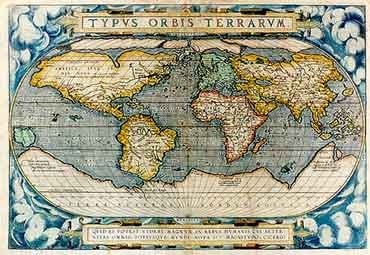
The plain paperback cover, adorned by a rather stern portrait of Ortelius together with his last letter superimposed on to his “Typus Orbis Terrarum” gave nothing away about the sheer brilliance of this work. The book is well-constructed and in the Introduction van den Broecke explains the reasons for his research into a sample of on verso texts.
As he explains, the texts on the back of the maps, and not just those by Ortelius, is a neglected field of research by both cartographic historians and by scholars of the Renaissance. So, dedicating time, energy and expertise, he translated all 226 map texts and set out to make a detailed study of them. Among the questions he asked were just what principles governed Ortelius in writing them; what is the relation between the texts on the map and the text printed on the verso; what is the nature of additions and changes made to the text in the various editions; why did Ortelius distinguish between his readers by producing “scholarly” and “vernacular” versions [not a universally popular idea as revealed in a surviving letter written by Claes Govaertszoon to Ortelius (Hessels No. 241) in which he bitterly complains about “the great disadvantage to us Dutch” to which I failed to spot a reference]; what bibliographical sources did Ortelius use for his classical references, either from his own library or from other sources; and just what influence did Ortelius’ map texts exert on contemporary and successive cartographers. To find the answers, van den Broecke selected a carefully chosen “random” sample of ten maps (having the total text corpus of an estimated 6 million words included in the study would have been an almost impossible task): Africa, Scotland, the Low Countries (Germania Inferior), Como, Rome, Friuli (Lacus Comensis), Hungaria (by Lazius), the Northern Regions (Scandia ..), Russia, East Indies (India Or.), Ancient Sicily (Sicilia ..), and Ancient Greece (Graecia …).
The author, being a linguist, also explains the difficulties encountered in translating texts into or from other languages when no exact equivalent meanings exist. He gives credit to Ortelius for the innovative way he managed to handle cultural, political and social differences between countries with different languages. This reviewer, himself a sometime translator and interpreter, experiences similar problems when handling medieval texts.
In Chapter 2 all editions of the Theatrum are listed, including year, language, number of map sheets, the estimated number of copies printed, provenance and location of the work used for translation (16 copies in the author’s own possession!). Also, the number given to it by van der Krogt, and finally the number of versions (variants) for each edition. Estimated number for atlases printed (about 8,175) and copies in existence (2,200) are also given which is a useful, but sometimes contentious indicator of surviving atlases (a survival rate of nearly 27%).
Amongst other topics, the author enquires into Ortelius’ quite formidable knowledge of languages, sets out his own translation procedure and examines the textual developments in the editions which appeared after Ortelius’ death in 1598. A two-page section is devoted to the subject of identifying a loose map.
Chapter 3 contains the translations of the title of all 10 selected maps with plate size and scale. This is followed by the listing of the editions, each with page number, estimated number of copies printed (in brackets), and “last line” characteristics for each edition. The main characteristics of the various states of the map in question are also described and the references given will guide readers to the relevant literature. This is followed by the translation of the main on verso text (both “scholarly” and “vernacular” versions) with a list of bibliographical sources occurring in them.
Chapter 4 deals with relation of the text on the map itself and its relation to the text on the verso. The shortest, but nonetheless important chapter in which the author introduces scientific methods for identifying and comparing some significant text on the face of the map to that of the on verso text, thus establishing that Ortelius was the first to use text to support the information contained on the map, and not visa-versa!
Chapter 5 is for the purists, linguists and micro analysts. I found the comparison between the “scholarly” and the “vernacular” text, and the number of changes introduced in each edition most interesting, although others may and will find different aspects of this chapter to their liking.
Chapter 6 deals with Ortelius’ sources through books, his large circle of correspondents, and the number of learned and influential friends, like Carolus Clusius, the botanist, and Justus Lipsius, humanist, historian and philosopher, (and of course his nephew, Jacobus Colius Ortelianus) with whom he kept in constant contact. Ortelius’ own considerable library of books and manuscripts is considered as the main source of his information (a library admired by many, including his friend Lipsius). It was inherited by his nephew, Colius, who donated both the library and the letters of his uncle to Cambridge University. The author laments that these await thorough research. A list of all the authors mentioned in the 10 selected map texts is also given together with the biographical and bibliographical information, which is very useful.
In Chapter 7 the author turns his attention to the influence or otherwise of Ortelius’ map texts on the texts written by his contemporaries and successors like De Jode, Bouguereau, Mercator, Hondius, Janssonius and the Blaeu family. Each is closely examined in detail. For those who find such detailed study daunting, Van den Broecke provides a help-line in the next chapter.
However, I am perplexed by the omission of an index of names in this work as it would have greatly helped in locating references to individuals. However, this could be the result of an editorial knife, rather than the author’s reluctance to include one. Apart from this, a bracketed misquote on page 290 regarding the Iceland map, and two other minor details are worth mentioning. Another is the cover, which is one of a series and obviously has to conform to its predecessors, but could have been more colour sensitive and had the more “dignified” maroon instead of the “pea soup” green. But these are just minor blemishes in an excellent scholarly work which I can thoroughly recommend.

Lászlo Gróf, Oxford, England.

+++++++++++++++++++++++++++++++++++++++++++++++++++++++++++++++++++

ORTELIUS – THE WORDS BEHIND MAPS

Reviewed by Fredric Shauger in The Portolan, December 2009.

In his latest work, Marcel van den Broecke begins to fill a void that has existed for 440 years. Scholars began studying maps in Abraham Ortelius’ Theatrum Orbis Terrarum almost from their debut in 1570. The texts on the reverse side of the maps (“on verso”) however, were basically ignored. Peter van der Krogt noted “It is remarkable that so little attention has been devoted to these texts. Brandmaier (1914) is the only author who devoted systematic research to these texts and their sources. After him, only Van den Broecke paid attention to texts”. Van den Broecke himself acknowledged that the on verso texts had been “neglected” in 1996 when he published his iconic Ortelius Atlas Maps, an Illustrated Guide.

This book is actually a dissertation that Van den Broecke recently defended at Utrecht University. In it he not only translates a selection of the on verso texts but analyses and compares them. Acknowledging that all the texts add up to approximately six million words, Van den Broecke elects to analyze ten carefully chosen samples – eight “modern” maps and two from the Parergon. The ten texts analyzed, with their “Van den Broecke” numbers from his illustrated guide, are Africa (Ort 8), Scotland (Ort 18), the Low Countries (Ort 58), Como, Rome and Friuli (Ort 129), Hungary (Ort 150), the Northern Regions (Ort 160), Russia (Ort 162), the East Indies (Ort 166), and from the Parergon Ancient Sicily (Ort 211) and Ancient Greece (Ort 215). From his analysis, Van den Broecke concludes that the on verso texts, rather than the maps, are actually more useful in determining from which edition of the Theatrum a particular loose map came. He notes that while the map plate would be reused, the text was broken down after each printing and reassembled for the next. Inevitably there were changes in font, spacing and punctuation, not to mention additions and deletions to the texts. The original texts were on one folio. Over time, as the texts increased in size, the font was made smaller to accommodate the increasing number of words. Eventually both reverse folios were used and then extra pages inserted. Revisions and additions along with supplemental information were added during the life of the Theatrum.

Van den Broecke’s commercial website, www.orteliusmaps.com contains all 226 maps from the various editions of the Theatrum and all on verso texts translated into English. Ortelius, who wrote the original texts, divided them into either “scholarly” languages (Latin, Spanish, Italian and English) or “vernacular” tongues (Dutch, French and German). The vernacular editions were designed to attract a less educated audience and thereby, a broader market. The vernacular editions were rarely changed during his life time.

Ortelius explains that he created the on verso texts “because we thought it to be unpleasant for the reader to poke his nose at them being completely white, we have about each map, (as far as we knew about it) written something which may represent a place of rest or recreation, where he (tired from all the traveling) may regain his breath before he resumes his travels” (translation by Van den Broecke). Despite that explanation, Van den Broecke opines that the real reason for the text was to convey the history of the mapped area. Van den Broecke notes that Ortelius did not consider himself a cartographer or a geographer. In his own eyes, he was an historian and he projected that passion onto others saying: “Everyone is interested in history, because everyone has a history of his own”.

The Theatrum has long been considered the first modern atlas. Van den Broecke validates that statement. By comparing the “text blocks” on the ten maps, to the on verso texts he notes that the vast majority of the text blocks rarely correspond to the on verso texts. Conversely, the on verso texts constantly refer to the maps and are dependent on them. The Theatrum therefore is the first book of maps with supporting text – not a treatise with supporting maps.

The Herculean task of translating and analyzing all the texts in seven languages (a total of 1,582) explains why Van den Broecke tackled only 10 of the 226 maps. He notes that the comparison and translation of 400 year old languages into modern English is a “near impossible” task. To further complicate the process, Ortelius himself wrote the on verso texts in Latin, Dutch and French. The Spanish translation was made by Balthasar Vincentius, the Italian by Filippo Pigafetta, and the English version by William Bedwell – the last two after Ortelius’ death in 1598. The German text was written by a Personae Incognitae. Because of cultural differences and the difficulty of transposition, Van den Broecke concludes that a fair amount of the information contained in the on verso texts has been lost in translation.

Throughout the book, Van den Broecke uses charts and lists to illustrate his points about the on verso texts. For example, table 5.1 demonstrates how the word count of the texts increase over the years; chart 6.4, beginning on page 190 and continuing to page 215, lists all of the source authors whose names appear anywhere in the 10 texts. From pages 148 through 176, Van den Broecke compares the varying translations among the seven languages and the various editions. He compares place names and notes that on the maps they are usually toponyms, whereas exonyms usually appear in the texts. By analyzing the list of source authors and references in the 10 maps, Van den Broecke is able to conclude that the books and manuscripts that Ortelius consulted came primarily from his own library. As Ortelius added to his library, he revised the texts.

Despite the fact that the Theatrum was the first to include on verso texts, Van den Broecke compares them with some of Ortelius’ contemporaries and successors. In doing so, he gives vignettes of 16th century Antwerp, the map trade and Ortelius’ relationships with his colleagues. There is an interesting discussion of Ortelius’ attempt to suppress competition and his bitter rivalry with Gerard de Jode (1509 – 1591). While de Jode’s maps had on verso texts, they frequently repeated the text blocks that appeared on the maps. Another of Ortelius’ contemporaries was Maurice  Bouguereau who published an atlas of France (1595). Rather than rivals, the two cooperated and exchanged cartographic information. Bouguereau’s on verso texts were totally different from Ortelius’. The most interesting comparison is between Ortelius and Gerard Mercator (1512 – 1594). Both men admired each other, traveled together and were friends. Ortelius referred to Mercator as “the Ptolemaeus of our time”. Mercator, however, did not employ on verso texts. As the successor to Mercator’s work, Jodocus Hondius (1563 – 1612), in preparing his atlas, used Ortelius’ on verso texts extensively. Ortelius’ innovations, including the on verso texts, continue to influence the map trade well into the 17th century as demonstrated by the maps of Jansson and Blaeu.

There is a CD inserted into the back cover that contains photos of the ten maps and all the various on verso texts analyzed. Van den Broecke warns his readers that “the quality of these photographs varies per photograph, depending on the circumstances and the equipment used”. However, he states that the purpose of including the CD is to allow “the reader to check the accuracy of the translations given …” That goal would be better served were it not for the fact that many of the photographs are dark and blurry, while others are completely illegible. Some of the photographs show bowed pages that appear clear in the center but grow increasingly blurry toward the edges. Many photos are taken too far away and a significant number of the texts are so small as to be unreadable. Professionally taken photographs would have helped.

Marcel Van den Broecke is the preeminent Ortelius scholar of our age. Anything from his pen is a welcome addition to our understanding of this truly innovative man and his monumental work – the Theatrum. One can only hope that Van den Broecke will analyze and publish all of the on verso texts. Ultimately, however, Van den Broecke recognizes that he may never be able to complete the task. He concludes by repeating Ortelius’ oft quoted comment: “I did what I could, not what I wanted to”.

Fredric (Fred) Shauger is a map collector living in New Jersey. His modest collection includes maps from the “Age of Discovery” of places to which he has traveled. He is a member of the Washington Map Society, IMCoS, the Philip Lee Phillips Society, the Society for the History of Discoveries and is Vice President of the New York Map Society.

+++++++++++++++++++++++++++++++++++++++++++++++++++++++++++++++++++++++++++++++++++++++++++++++++++++


In: Imago Mundi, Volume 62, part 1, 2010, pp. 116-117.

Marcel van den Broecke has already placed his mark indelibly on Ortelius scholarship with a series of articles and his invaluable 1996 handbook Ortelius Atlas Maps: An illustrated guide. With the book reviewed here, he directs his attention on the other side of the sheet, to the textual matter printed on the versos of the maps in all editions of the Theatrum. He summarized this topic in 2008 in an article in the pages of this journal (60:2: 202-210), but his concern here is to provide a detailed examination of a sample of ten texts, analyzing their language, content and sources, their relationship to the maps on which they are found, and comparing them with comparable texts in atlases by Ortelius’ contemporaries and successors.

His ten sample texts are well selected to provide a good cross-section of the Theatrum in terms of geographical area, chronology of publication and modern versus historical maps: Africa, Scotland, Germania Inferior, Lacus Comensis, Hungaria, Scandia, Russia, India, Sicilia, and Graecia (the last two are historical maps from the Parergon). He presents and analyzes his ten sample texts through English translations, but the accompanying CD contains all the variant versions of a text in all the languages, as well as images of the maps proper. Thus, for the Africa text (van den Broecke’s Ort8) we find on the CD no fewer than 29 images of the original texts, in Latin, Dutch, German, French, Spanish, English and Italian, each representing a different setting of type. As van den Broecke pointed out in his article in Imago Mundi, Ortelius wrote two versions (“templates”) of most of his texts: a “scholarly” version for use in the Latin editions, and a second, simpler version for use in editions in the vernacular. A rather forbidding (but perfectly logical) system of bracketed insertions is used to record all substantive changes to the text in any language. Thus, for the ten sample texts, the book provides, in effect, a variorum edition.

A brief fourth chapter analyzes whatever blocks of texts appear on the map proper and compares them with the on verso text and concluded that they were largely independent; that is, the texts on the map proper and the on verso texts for the most part relate different information.

Chapter 5 is devoted to “Characteristics, Developments, and Transparence of Translated Map Texts”. Van den Broecke’s task, in brief, is “to compare similar texts across languages”. One finding is that the scholarly texts were more likely to grow over time, while the vernacular texts showed no increase in size. Clearly, Ortelius had different readers in mind for these editions, something that no other study has recognized. Another thing revealed by van den Broecke’s analysis is that the number of references to sources increased in each successive scholarly edition, sometimes markedly: the texts of the 1570 Latin edition referred to almost 100 books, that of the 1595 Latin edition (the last to be published during his lifetime), to nearly 250 books.

The final, and longest section of the chapter studies the nature of the translations, using the linguistic technique of “difference measure” to express “the amount of transparence between words and expressions intending to mean the same thing”. Van den Broecke concludes from this that “most translations analyzed here are a fair approach to Ortelius’ original scholarly Latin or vernacular Dutch example in terms of preserving meaning, if not form.

Chapter six presents an analysis of the sources cited by Ortelius in his on verso texts. The results are enlightening about the depth of Ortelius’ reading, the value he put on the various texts, their availability in the sixteenth century, and the accuracy of Ortelius’ citations of those texts. I confess I was surprised to learn that, among other things, “the library that Ortelius built in the course of his life must have been the largest private library, not only of Antwerp, but conceivably of North-Western Europe”. The final chapter compares Ortelius’ texts with those of his competitors and contemporaries, and concludes that his are uniquely authoritative and informative.

Having just read Denis Wood and John Fels’s  The Natures of Maps, entirely devoted to twentieth-century cartography, I have a new appreciation for the importance of what they call the “paramap”, defined as “everything that surrounds and extends the map in order to present it”. Van den Broecke’s careful and painstaking analysis provides a fine model for future investigations of the “paramap” in history.

Robert W. Karrow, Jr. The Newberry Library, Chicago.      

++++++++++++++++++++++++++++++++++++++++++++++++++++++++++++++++++++++++++++++++++++++++++++++++++++++++

Web recensie BMGN 126.2 (2011) by Dirk Imhof, Museum Plantin-Moretus Antwerpen, translated from the Dutch original:

In 1570 the first atlas in history appeared: the Theatrum Orbis Terrarum of Abraham Ortelius. Ortelius ordered the best maps which were available at that time in Europe to be engraved in similar format and assembled them into one book. On the backside of the maps, he ordered accompanying text to be printed. I contrast to earlier works containing maps, Ortelius’ texts were a clarification of the maps, rather than the other way around. As early as in the first edition, Ortelius invited his readers to send maps to him of regions which did not yet occur in his atlas. As a result, new editions regularly appeared with an ever-increasing number of maps: from 53 maps in 1570 to 166 maps in later edition in the seventeenth century. Next to Latin editions, there also appeared editions with texts in Dutch, French, German, Spanish, Italian and English. Whereas so far maps have been the main focus of research, Marcel van den Broecke now focuses on the texts on verso of the maps of Ortelius’ atlas.

Van den Broecke studies the relation between the Latin texts and the texts in other languages, how texts developed in subsequent editions and the sources Ortelius used. The texts are an interesting topic for research. Not only is the addition of texts to accompany maps a novelty that Ortelius devised, but also did he extend the texts in subsequent Latin editions, adding new information, replacing obsolete information with novelties which he had meanwhile found.
His Latin texts were largely based on his thorough knowledge of classical authors and contemporary historical works. As one of few authors of his time, he referred systematically to his sources, and even included in his atlas a “Catalogus Auctorum” with a clear listing of all authors and geographers whose work he had used. In contrast to his Latin texts, his texts in Dutch, French and German are not intended for the learned reader, but for a public that could do without quotes from classical authors. These text express personal views on the countries depicted “which provide a resting place for the reader, tired as he is from scanning the maps, so that he can regain his breath” as Ortelius puts it. The Spanish, Italian and English editions are all translations from the Latin editions. For his research, Van den Broecke selected ten texts out of a total of 226. Research on all texts would go too far. The ten texts he selected belong to maps that appeared in the earliest as well as the latest editions and which appeared in all languages mentioned. In his book Van den Broecke presents these texts in English translation extensively, indicating what was added, removed, or replaced in subsequent editions. These texts are analyzed statistically in great detail. In spite of the interesting subject of this study, Van den Broecke has a few serious shortcomings. The author presupposes that the ten texts selected are representative but this presupposition also has risks. Replacement of an entire text by a different text is not discussed. Nor is the book always sufficiently accurate about the exact evolution of the various editions of Ortelius’ atlas. Nowhere is made clear that the composition in French editions, always attributed by the author to Ortelius himself, in the course of time begin to contain texts from different origins. Thus, the French edition of 1598, the last one to appear in Ortelius’ lifetime, contains next to texts from the first French edition also about ten texts which are in fact translations from Latin, made by typesetter of Jan Moretus called François Bellet. That Ortelius differentiated between texts in Latin for a educated public, and texts in Dutch, French and German for other interested readers is something which Van den Broecke might have tested with the help of ledgers that have been preserved in the archive of the Plantin bookshop, where a large number of Ortelius’ atlases were sold. The buyers and their particulars are mentioned there by name, so that the author could have tested his presupposition that these atlases were intended for “merchants, high ranking civil servants and dignitaries.

In his sixth chapter Van den Broecke researches Ortelius’ sources. If Ortelius indeed effectively possessed all the 2000 books which he mentions as a source in his texts, he must have possessed a very rich library for the time. Van den Broecke supposes incorrectly that this library has ended up in Pembroke College in Cambridge via Ortelius’ nephew Cools. Ortelius’ library has been auctioned in Antwerp and was dispersed in this manner.

In his last chapter, Van den Broecke compares the texts of Ortelius’ atlas with those in other atlases: those of his contemporary Gerard de Jode, the Frenchman François Bouguereau, Gerard Mercator, Judocus Hondius and Jan and Willem Blaeu. The author concludes that Ortelius’ historical texts represent a unique position, whereas the remaining texts are more directed at geographical information. Ortelius historical map texts turn out to have had followers for a long time afterwards.

It is questionable that Van den Broecke completely ignores Ortelius’ pocket atlas or Epitome which first appeared in 1577, followed by sequels for some decennia, containing accompanying texts.

Postcript by marcel van den Broecke:

I agree with all that Dirk Imhof, an excellent Ortelius scholar whom I often cite as a source with due acknowledgements, says here, except for his last remark. The first Epitome was made by Heyns and Philip Galle during Ortelius’ lengthy absence from Antwerp on account of the first Spanish fury. In its introduction, Heyns and Galle, both friends of Ortelius, speculate on Ortelius’ reaction to this Epitome. Would he be angry that they had used Ortelius’ maps and texts without his consent, or would he regard it as an advertisement for his own atlas? When Ortelius finally returned, he did not object to their initiative but condoned it. Nowhere does Ortelius ever refer to these Epitomes. He was simply not involved, intellectually, emotionally or financially but permitted the usage of his name, Heyns being in financial straits. Other authors followed with other Epitomes, with an ever-weakening relation to Ortelius’ atlas. This is the reason why I did not discuss it in my 2009 book. Meanwhile I wrote an article in Dutch which appeared in Caert-Thresoor (2011) p. 47-51, concluding what I summarize in these lines.

=========================================================================================


For comments or questions concerning this page, please send an email to info@orteliusmaps.com.