Cartographica Neerlandica Background for Ortelius Map No. 194
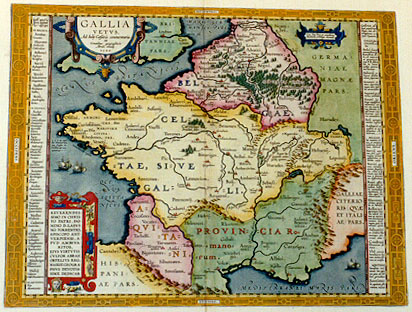
Title: GALLIA | VETVS, | "Ad Iulij Cęsaris commentaria. | ex | Conatibus geographicis | Abrah. Ortelij. | 1590". [Ancient France as it appears in Iulius Cęsar's Comments, from the geographical efforts of Abraham Ortelius, 1590.] (Cartouche top right:) "Cum Imp. Reg. et cancellarię | Brabantię priuilegio decennali". (Cartouche lower left:) REVERENDIS:|SIMO IN CHRIS:|TO PATRI, DO:|MINO D. LAEVI:|NO TORRENTIO, | EPISCOPO ANT:|VERPIENSI, A:|PVD AMBIVA:|RITOS, | EIVS VIRTVTIS | CVLTOR ABRAH. | ORTELIVS REG. | MAIEST. GEOGRA:|PHVS DEVOTIS:|SIME DEDICAB. [Abraham Ortelius, his majesties royal geographer, dedicates [this map] in devotion to the lord and master, highly praised in Christ, Mr. Lęvinus Torrentius, bishop of Antwerp for the Ambivirate people, adoring his virtues]. (With a list of tribes and people of those tribes mentioned by name in Cęsar's writings (left edge) and tribes (right edge) in Gallia, as described by Cęsar.).
Plate size: 364 x 467 mm.
Scale: 1 : 4,000,000.
Identification number: Ort 194 (Koeman/Meurer: 18P, Karrow: 1/176, vdKrogtAN: 4000H:31A).
Occurrence in Theatrum editions and page number:
1590L4Addblank (100 copies printed) (identical to 1592L in text and typesetting, but here without page number; last line first text page, right aligned, : parent. ; last line second text page, left aligned, in cursive script like one line above it: "Cęsaris traditione in tres partes diuisionem quę postea,sub Augusto Imp.nempe,in quator prouincias diuisa fuit."),
1591G4Addblank (75 copies printed) (last line, full width, in Gothic script: lincker handt/wan sie nüchter sein/sehen auch nit zu ruck: welches sie wider alle gebrechen der schwein uń rinder gebrauchen/wie derselbe Plin. bezeugt.),
1592L5 (525 copies printed) (identical in text and typesetting with 1590L4Add, but here with page number 5; last line first text page, right aligned, : parent ; penultimate line: dia habetur,confidunt;in loco sacrato.huc omnes vndique qui controuersias habent,conueniunt:eorumque iudiciis, decretisq. ; last line second text page, left aligned, last line above two sides of an ancient coin: coloribus vestes addit. vnde hęc hauserit,ignoro, nam candidam vestem his tribuere Plinium,diximus.),
1595LE (500 copies printed) (last line first text page, right aligned: contro-; penultimate line: comœdię,quę Plauti nomen pręfert)quę regio totius Gallię media habetur,confidunt; in loco sacrato. huc omnes vndique qui ; last line second text page, above two coins, in cursive script, left aligned: "Cęsaris traditione in tres partes diuisionem;quę postea , sub Augusto Imp.nempe , in quator provincias diuisa fuit".),
1601Lxiij (last line first text page, right aligned: Gab. ; last line second text page, in cursive script like one line above it, left aligned: "tes diuisionem; quę postea, sub Augusto Imp.nempe, in quator prouincias diuisa fuit."),
1602G12 (250 copies printed) (last line, full width, in Gothic script: lincker handt/wan sie nüchter sein/sehen auch nit zu ruck:welches sie wider alle gebrechen der schwein uń rinder gebrauchen/wie derselbe Plin. bezeugt.),
1603Lxiij (300 copies printed) (text and page number, but not typesetting, identical to 1609/1612L/S; last line, first text page, right aligned: immo- ; last line second text page, above two sides of a coin, in italic script: "tres partes diuisionem ; quę postea , sub Augusto Imp. nempe , in quator prouincias diuisa fuit".),
1606Exiij (300 copies printed) (last line, first of two text pages, italic like the entire text, full width: "and mediation to leaue off fighting,and will not offer to strike one stroke more. Thus euen amongst the most barbarous people that are,rage giueth place to wis-/dome", ; last line second text page, left aligned, in cursive script: "with fine linnen frocks put ouer them, fastened together with a button, girt with a brasen girdle, and bare footed".),
1608/1612Ixiij (300 copies printed) (last line first text page, right aligned: volta ; last line second text page, left aligned, in cursive script like one line above it: "sare ; la qual dapoi sotto Augusto Imperatore fu distinta in quattro Prouincie".),
1609/1612L/Sxiij (600 copies printed) (page number identical to 1603L but typesetting is different; last line first text page, right aligned: vidisse; last line second text page, left aligned, italic: "nis,ex Cęsaris traditione, in tres partes divisionem;quę postea,sub Augusto Imp.nempe, in quator provincias diuisa fuit".),
1624LParergon/1641Sxvij (1025 copies printed) (last line second column first text page, in cursive script: "Aut solis nescire datum: nemora alta remotis/Incoli-" ; last line second column second text page: gusto Imp.nempe,in quator prouincias diuisa fuit.).
Approximate number of copies printed: 3975.
States: 194.1 from 1590L4Add as described.
194.2: in 1595, a number of topographical names were added: near the Pyrenees: "Elu:|sates" and "Ausci", south of Paris "Drui:|dum sedes" becomes "Druidum sedes." "Agendi:cum" has been added just Northeast of the previous item. "Cavillonum" has been added near Luxemburg.
194.3: in 1624 a third state appears which is very similar to the second state but which has "CHRI:|STO" instead of "CHRIS:|TO in the dedication cartouche in the lower left corner. In the list of famous people along the left edge also shows differences between the second and the third state: "Commius" becomes "Cominius"; "Verodoctus" becomes "Verodoctius"; "Divicus" becomes "Divico". In Ortelius Atlas Maps (1996), I wrongly assumed that this last state derived from a new plate which I called Ort195.
Cartographic sources: made by Ortelius on the basis of ancient information from Cęsar's De Bello Gallico.
Remarks:
The text opens by saying that this map is only based on Cęsar's commentaries, which is true for the map but not for its text; the text also promises to finish the discussion on the Druids to turn to other matters, but in fact a great number of other text sources next to Cęsar are referred to as well, and the text is entirely devoted to the Druids.
For questions/comments concerning this page, please e-mail info@orteliusmaps.com.